Reverse logistics in the automotive industry requires control, efficiency, and standardization. Unlike other sectors, here the return flow is not optional. It’s part of the operation.
Parts, components, returnable packaging, and transport structures constantly circulate among suppliers, automakers, and distribution centers. When this process isn’t well structured, problems arise such as asset losses, increased costs, and lack of logistics control.
It’s in this scenario that the rotomolded plastic pallet takes center stage in reverse logistics. It stops being just a physical support and becomes a strategic part of the industry’s systems.
In this content, you’ll understand how this solution directly impacts the efficiency of the automotive industry.
What is reverse logistics in the automotive industry?
Reverse logistics is the set of actions and procedures used to enable products and packaging to return to the production cycle or to environmentally appropriate disposal.
In the automotive sector, this includes:
- returnable parts
- industrial packaging
- transport structures
- reusable components
This flow is continuous and needs to be controlled.
Unlike sectors with one-off disposal, the automotive industry works with closed logistics cycles. This requires means designed to enable transport, return, and reuse with high efficiency.
The role of the rotomolded plastic pallet in reverse logistics
The rotomolded plastic pallet acts as the structural foundation of this system.
It allows loads to be organized, transported, and stored in a standardized way, easing the entire reverse flow.
In addition, it contributes to:
- less waste generated
- longer packaging durability
- better logistics control
Unlike materials such as wood or metal, rotomolded plastic offers lightness and strength, characteristics essential for automated operations.
Challenges of reverse logistics in the automotive sector
Companies in the sector face specific challenges.
The first is the volume of movement. Components constantly circulate between different points in the chain.
Another challenge is standardization. Without a proper structure, each stage of the process generates variations that compromise efficiency.
There’s also the matter of automation. Many operations use robots and automated systems, which require dimensional precision.
When these factors aren’t well managed, problems arise such as:
- lost packaging
- increased operating costs
- rework
- lost productivity
Practical case: transforming mirror logistics
A clear example we handled here at Tecnotri came from an automotive company that used metal cages to transport mirrors.
The problems were recurring:
- heavy structure
- rust from environmental exposure
- low logistics efficiency
On top of that, the operation was automated. Robots traveled about 12 km per day inside the factory.
The solution needed to meet specific criteria:
- lower weight
- compatibility with automation
- 27 cm height
The solution developed was a hybrid system. The pallet also began functioning as a folding box.
When full, it acts as transport packaging. When empty, it collapses and becomes a pallet.
This model brought direct gains to reverse logistics.
The return trip started taking up less truck space, cutting logistics costs and increasing efficiency.
Lightness and strength as critical factors
In reverse logistics, weight directly impacts cost. Heavy structures increase fuel consumption and make handling harder.
The rotomolded plastic pallet solves this problem.
It combines lightness and strength, enabling:
- easier handling
- less operational effort
- compatibility with automated systems
In addition, its structure withstands multiple cycles without loss of performance.
Hygiene and traceability in the reverse flow
Another important point is control.
A reverse logistics requires traceability. You need to know where each asset is, in what condition, and at which stage of the process.
The plastic pallet makes this control easier. Its surface allows for codes, identification, and system integration.
It also offers better hygiene. Unlike wood, it doesn’t absorb residue or accumulate dirt, which is essential for keeping the environment appropriate.
Reducing operating costs
Adopting plastic pallets has a direct impact on reducing operating costs.
This happens because they:
- reduce asset losses
- reduce the need for replacement
- improve transport efficiency
- optimize logistics space
With collapsible solutions, as in the automotive sector, the gain is even greater. The return trip takes up less space, allowing more efficiency in reverse transport.
Durability and life cycle
Durability is one of the main differentiators.
While traditional materials wear out quickly, the rotomolded plastic pallet has a long service life.
This allows multiple cycles within reverse logistics without the need for constant replacement.
In addition, when damage does occur, the material can be reprocessed. This reduces waste and reinforces the commitment to the environment.
TecCube: the evolution of the plastic pallet in reverse logistics
If your operation already faces challenges with packaging returns, space usage, and transport costs, there’s a point that needs closer attention.
It’s not enough to just return the asset. It needs to be returned efficiently.
It’s in this context that TecCube positions itself as an evolution in the use of plastic pallets in reverse logistics.
It’s a modular returnable packaging system that combines a pallet, side structure, and lid into a single smart solution.
How TecCube works in practice
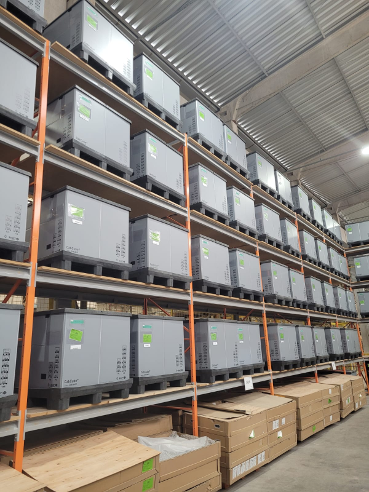
The system is made up of three integrated parts:
- a plastic pallet base that ensures stability and handling
- a foldable sleeve that forms the box structure
- a lid that protects and allows safe stacking
When assembled, it works as a sturdy pallet box for transport.
When empty, the system collapses.
This drastically reduces the volume on the return trip.
Real space reduction on the return trip
One of the biggest hidden costs in reverse logistics is empty transport.
Trucks returning with low load utilization generate logistics waste.
TecCube solves this problem directly.
When folded, it can reduce the volume occupied on the return trip by up to 75%.
In practice, this means:
- more units transported in the same truck
- fewer trips needed
- significant reduction in operating costs
If your operation currently suffers from high return costs, this is a critical point.
Real logistics gains in operation
In the automotive industry, contracts already operate at the cost limit.
That’s why most of today’s reduction opportunities are concentrated in logistics.
This is exactly where TecCube generates direct impact.
In auto parts operations, increased load capacity and better use of truck cubic space made it possible to significantly reduce the number of trips.
In practical applications, it was possible to eliminate up to 3 trucks for every 10 operations performed.
This happens because the system makes better use of the trailers’ internal height, both for full transport and empty returns.
While traditional packaging wastes space, TecCube enables:
- better load occupancy
- reduced transport of idle volume
- fewer trips in the reverse flow
- more operational efficiency
Load protection and loss reduction
Another recurring problem in the automotive industry is damage during transport.
Components such as mirrors, technical parts, and sensitive items require protection.
TecCube uses technology that increases impact absorption and reinforces the structure.
This ensures:
- lower risk of damage
- more transport stability
- greater load integrity
In high-value operations, this has a direct impact on financial results.
Integration with automation and industrial operations
Automotive logistics demands precision.
Height, fit, and standardization are not optional.
TecCube was developed to work in automated environments.
It’s compatible with:
- forklifts
- pallet jacks
- robotic systems
This eliminates improvised workarounds and improves flow within the plant.
Sustainability and waste reduction
Beyond logistics efficiency, there’s growing pressure for sustainability.
Reverse logistics needs to reduce waste generated and ensure a continuous cycle.
TecCube meets this need because it:
- is reusable
- has a long service life
- can be recycled at the end of its cycle
This directly contributes to an operation more aligned with the environment and shared responsibility practices.
When TecCube makes the most sense
Using TecCube is strategic for operations that have:
- high return volume
- a need to reduce logistics costs
- transport of sensitive products
- integration with automation
- continuous reverse logistics cycles
If your operation faces any of these issues, this solution stops being optional.
It becomes an efficiency decision.
Reverse logistics and sustainable development
Reverse logistics has a direct impact on economic and social development.
By reducing waste generated and promoting reuse, the industry lowers its environmental impact.
It also creates more efficient and sustainable processes.
This strengthens companies’ competitiveness and contributes to a more responsible production model.
If you’d like to understand how reverse logistics impacts other sectors, check out our content:
The importance of reverse logistics in the chemical and pharmaceutical industry
Integration with reverse logistics systems
To work well, reverse logistics needs to be structured as a system.
This includes:
- asset control
- packaging standardization
- flow definition
- transport integration
The plastic pallet makes this integration easier.
It acts as a standardizing element, connecting different stages of the operation.
If you’d like to dive deeper into the role of pallets in this context, check out our content:
The importance of plastic pallets for reverse logistics
Learn more about unitizing devices and their application in reverse logistics in this article:
What is the role of unitizing pallets in reverse logistics
10-year warranty to transform your reverse logistics
If your operation faces problems with packaging returns, asset losses, or low logistics efficiency, it’s time to review your structure.
Tecnotri develops rotomolded plastic pallet and plastic bin container solutions designed for intense operations and continuous cycles, with proven durability and a 10-year warranty.
Talk to our team and find out how to optimize your reverse logistics with greater safety, control, and long-term savings.