We have the privilege of living in one of the countries that are home to most of the water available for consumption in the world. Brazil has more fresh water than any other country, yet we can already feel the effect of scarcity. Whether in regions in the interior of the northeast – which have historically suffered from droughts – to more recent episodes in large centers such as São Paulo, which have suffered from water rationing.
Finding ways to save and avoid wasting this essential resource for life is what can help us prevent episodes like this from getting even worse. On World Water Day, we prepared this special article for you who want to know more about how to do your part and find alternatives to use water more efficiently, without waste and saving money.
Why is World Water Day celebrated?
World Water Day is celebrated across the world to raise people’s awareness of the importance of this natural resource in various aspects of our everyday lives, including the environment, health, agriculture and commerce.
The day was defined as an annual event in 1993 by decision of the United Nations General Assembly. Since the beginning of the celebration of this date, the UN has been responsible for selecting the theme for World Water Day, directing efforts towards awareness-raising projects and practical activities around a unique theme throughout the world.
A drop of hope
Governments and NGOs participate in the date by promoting World Water Day celebrations, drawing public attention to the most critical issues regarding access to water in the world. This year, the theme is “Leave No One Behind.”
“Access to water is a right vital to the dignity of all human beings. Yet billions of people continue to be deprived of this right.” Said the director-general of the United Nations Educational, Scientific and Cultural Organization (UNESCO), Audrey Azoulay.
Access to water and sanitation is internationally recognized as a human right. Even so, more than 2 billion people still suffer from water scarcity, although many advances have been made in recent years.
Some numbers about water in the world:
- 2.1 billion people live without drinking water at home;
- About 4 billion people – almost two-thirds of the world’s population – suffer severe water shortages for at least one month of the year;
- Globally, 80% of people who use unsafe and unprotected water sources live in rural areas;
- More than 700 children under the age of five die every day due to diarrhea linked to contaminated water and poor sanitation.
What can you do to preserve water?
Water is an abundant natural resource. It occupies approximately 70% of the surface of our planet. But 97% of this water is salty, therefore unfit for consumption. Less than 3% of the planet’s water is fresh, of which 2.5% is trapped in glaciers. Of the remaining 0.5% of water, most is trapped in difficult-to-access underground aquifers. We have 0.04% of water available on the surface, in rivers, lakes and mangroves.
On the other hand, with the use of domestic water storage systems, it is possible to reuse rainwater to wash sidewalks, outdoor areas, vehicles and for toilet flushing, to name a few examples.
It’s a smart way to preserve and also save some money by avoiding the use of piped drinking water in activities that require a large volume of this resource.
Cisterns: a practical and economical way to store water at home
By purchasing a cistern, you not only protect the environment, but you also guarantee savings of up to 50% on drinking water costs. Among the options available on the market, rotomolded plastic cisterns like those from Tecnotri have many advantages, as they allow water to be stored in a practical, economical and safe way.
The Tecnotri cistern, also known as the Water Reuse Kit, does not need to be buried, avoiding spending on works and changes to the residential plan. Adapts to garages, narrow hallways and small spaces. As it is predominantly vertical, compact and modular, it is ideal for all types of residences, regardless of size.
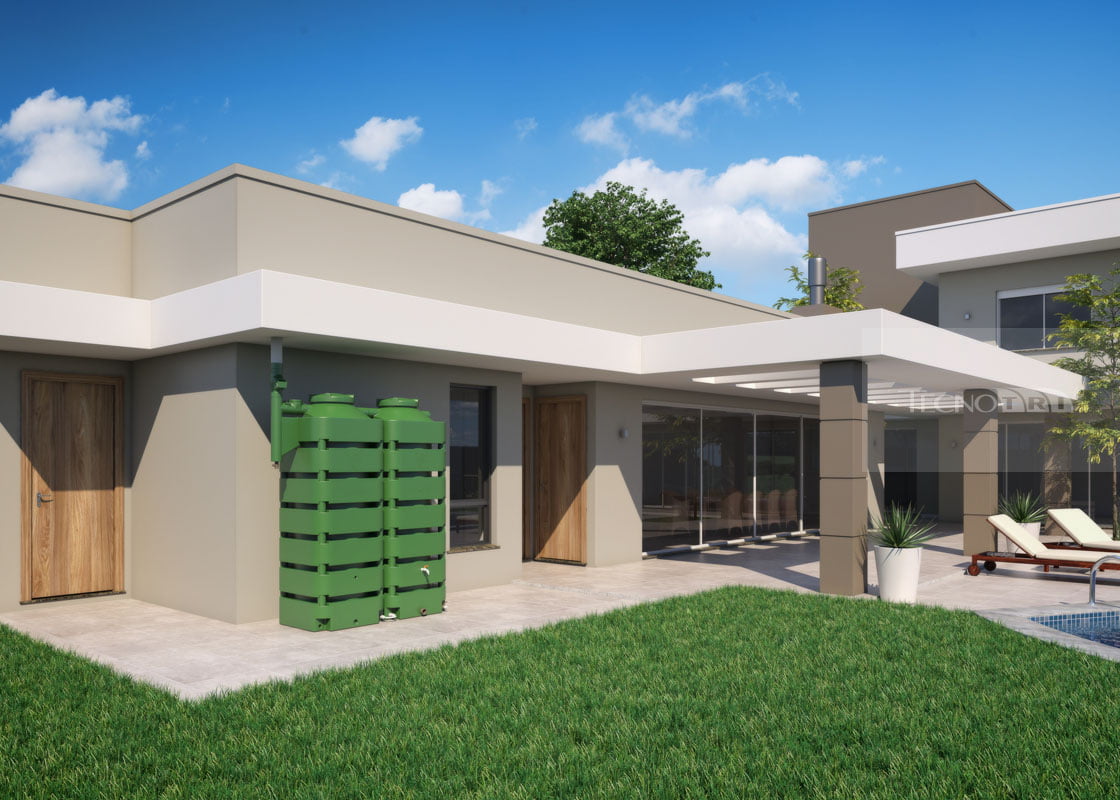
Among the models that stand out are the 1,000 L model, suitable for places where there is more floor space, and the 1,050 L model for environments with greater vertical space.
Do you already use cisterns in your home?
Learn all about Water Reuse Kits by clickinghere.
Vertical cisterns are a great option for those who are thinking about adopting this system but do not want to incur construction costs and have little space. Find a cistern model that best suits where you live and do your part in preserving this resource that is so important to our lives. And what’s better: saving money.
Speak to one of our consultants and ask your questions.