


Discover what a containment pallet is, what it’s for, and how to choose the right model to ensure safety, environmental compliance, and savings.
If your company stores drums, jugs, or containers holding chemical products, solvents, oils, or any liquid that could leak, you already know that a simple spill can lead to losses, environmental fines, and risks to workers. This is where the containment pallet stops being optional and becomes a strategic part of the layout.
In this complete guide, you’ll learn what a containment pallet is, how it works, the ideal capacity for each operation, and why Tecnotri is a national benchmark in rotomolded plastic for industrial logistics.
What is a containment pallet?
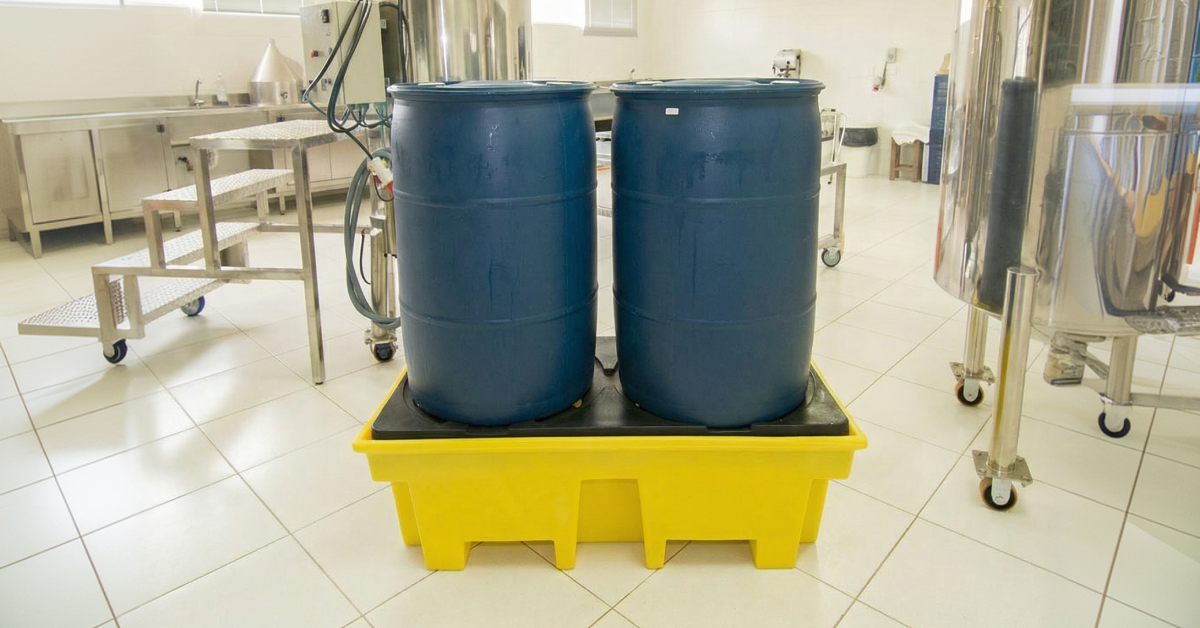
The containment pallet is a platform designed to store containers holding potentially polluting liquids, with a containment basin built into its base.
In practice, it works as a safety barrier. If a leak occurs, the spilled liquid stays contained within the structure itself, preventing soil contamination and environmental risks.
Unlike a conventional pallet, its main function isn’t just to support the load, but to ensure safe storage in line with health and regulatory standards.
How does a containment pallet work?
Drums or jugs rest on the pallet, with the removable grate being optional. If a leak occurs, the liquid flows into the containment basin, where it stays until proper disposal.
This system means the company doesn’t need to modify the floor or carry out structural work. In the chemical sector, for example, there’s no need to touch the warehouse structure if a product leaks. The solution is already built into the pallet.
Why is Tecnotri’s plastic different?
Tecnotri has 25 years in the market and is part of the Rototech Group, with an international presence. We work with rotomolded solutions for internal, external, reverse, and OEM logistics.
Our technical advantages include:
- Virgin raw material for lower contamination risk
- Resistance to temperature variations from -35°C to 60°C
- 10-year warranty
- 100% recyclable product
- Compliance with ISO 9001, ISO 14001, and IATF 16949 certifications
The use of virgin resin ensures sanitary safety and structural stability. This reduces the risk of cracking and warping over time.
Ideal capacity: how to choose correctly
Determining the ideal containment pallet capacity is a technical decision that directly impacts safety, environmental compliance, and operating costs. It’s not just about knowing how many kilos the pallet supports, but understanding the full context of use.
1. Total load weight
The first step is calculating the actual weight that will rest on the pallet.
It’s essential to consider:
- Weight of the empty drum or jug
- Weight of the stored liquid
- Total weight when there’s more than one container
For example, a 200-liter metal drum holding a chemical product can exceed 250 kg. With four drums on the same pallet, the load can exceed 1 ton.
2. Type of container being stored
The container’s shape directly affects weight distribution.
Metal drums concentrate load in specific points. Plastic jugs, on the other hand, may have an irregular base. IBC containers require a stable surface and high strength.
It’s essential to check:
- Contact area between the container and the grate
- Weight distribution
- Load height and center of gravity
If the center of gravity is high, the risk of tipping increases. In that case, the containment pallet should have a sturdy base and reinforced structure.
3. Containment volume required by regulation
The third factor is technical and regulatory.
The containment basin needs to hold a certain percentage of the stored volume. In many cases, the regulation requires retention of 100% of the largest container or 10% of the total stored volume, whichever is greater.
This means it’s not enough to support weight. You need to ensure that, in the event of a leak, all the spilled liquid is contained.
Choosing a model with an undersized reservoir can lead to non-compliance during environmental audits.
4. Support
Another point to consider is the type of support.
- Ground-level use
- Use on pallet racking structures
For this reason, it’s always best to validate the actual application with the manufacturer.
Impact of the right choice
Choosing correctly prevents:
- Overload and warping
- Structural cracking
- Improper liquid buildup
- Risk of accidents involving workers
It also extends the equipment’s service life and reduces future costs.
Main applications of the containment pallet
The containment pallet is widely used in sectors that store potentially polluting liquids or critical inputs: chemical industry, pharmaceutical, food, meatpacking, beverages, seafood, printing, and packaging.
Logistics gains and cost reduction
Investing in containment pallets has a direct impact on operational efficiency. Many companies only look at the initial cost. However, a proper analysis needs to consider the product’s full life cycle.
Fewer accidents
Leaks on the floor create a risk of slipping and contamination. With an integrated containment basin, the liquid stays contained within the structure, increasing safety for employees.
Fewer accidents mean fewer sick leaves and less labor liability.
A more organized layout
Standardization makes layout planning easier. Pallets have defined technical dimensions, which improves visual organization and internal logistics.
Organized environments increase productivity and make audits easier.
Greater safety for employees
Stable, sturdy structures reduce the risk of tipping. In addition, integrated containment prevents direct exposure to spilled liquid.
This creates a safer, more controlled work environment.
Less process interruption
Since the rotomolded containment pallet has high resistance, there are fewer emergency replacements. Less interruption means more productivity.
When you look at cost over 15 or 20 years, the savings are significant. Logistics gains add to the reduced environmental risk, creating a solution that protects the operation and strengthens the company’s image with auditors and customers.
Safe storage and environmental compliance
Environmental law requires strict control over the storage of chemical products.
Using integrated containment basins reduces the risk of fines and shutdowns. The company then operates within the standards required by internal and external audits.
In ISO audits, for example, adopting proper solutions strengthens the environmental management system.
Customization and co-creation with the client
An important advantage of Tecnotri is the ability to co-create with the client.
The rotomolding process allows for:
- Dimension changes
- Specific structural reinforcements
- Color customization
- Engraved identification
Custom projects are recommended when there’s recurring demand and a specific technical need.
Load resistance and durability
Rotomolded pallets offer high mechanical strength. Since they’re one-piece and have no seams, they withstand intense impacts without cracking.
In addition, the smooth surface collects less dirt, making cleaning easier and meeting health requirements.
Frequently asked questions about containment pallets
What is the volume of the containment basin?
It depends on the model. There are options for 1, 2, or 4 drums and for 1 or 2 IBCs, with proportional reservoirs.
Is it worth it financially?
Yes. Even though the initial investment is higher than a flexible version, the cost spread over 15 to 20 years makes the solution more economical. The same goes for comparison with masonry construction — you’ll get a lower cost and less headache over time.
Can you buy a ready-to-ship containment pallet?
Yes. Tecnotri has standardized models available in stock.
Why choose Tecnotri?
The decision shouldn’t be based on unit price alone.
- 25 years in the market
- Pioneering role in manufacturing containment pallets
- Rotomolding technology
- 10-year warranty
- Compliance with international standards
Talk to Tecnotri now
Stop taking risks with fragile or improvised solutions.
Contact Tecnotri right now, request a customized quote, and discover the ideal containment pallet model for your operation.
Protect your inventory, your team, and your business with a company that has 25 years in the market, its own rotomolding technology, and a real commitment to quality and durability.