Laboratory and healthcare companies operate under a high level of control, where precision is the rule. Every stage — from receiving raw materials to portioning inputs and final disposal — must follow strict criteria to prevent cross-contamination, ensure product integrity, and protect worker safety.
Operational complexity increases when different classes of materials coexist in the same space. Quarantined inputs, portioned reagents, and materials ready for analysis require distinct workflows and clear identification to prevent handling errors. In addition, efficient portioning management ensures that exact quantities are moved between storage and bench areas quickly and safely.
In this scenario, internal logistics solutions gain relevance not only for disposal, but as essential tools for input segregation and workflow organization. They act as visual and functional guides to standardize material handling at every stage. Learn more below!
Color-coded waste segregation: organization that reduces risk
Correct segregation is one of the foundations of health service waste management (RSS). Anvisa’s own RDC No. 222/2018 establishes that waste must be separated at the time and place it is generated, according to its characteristics and risks.
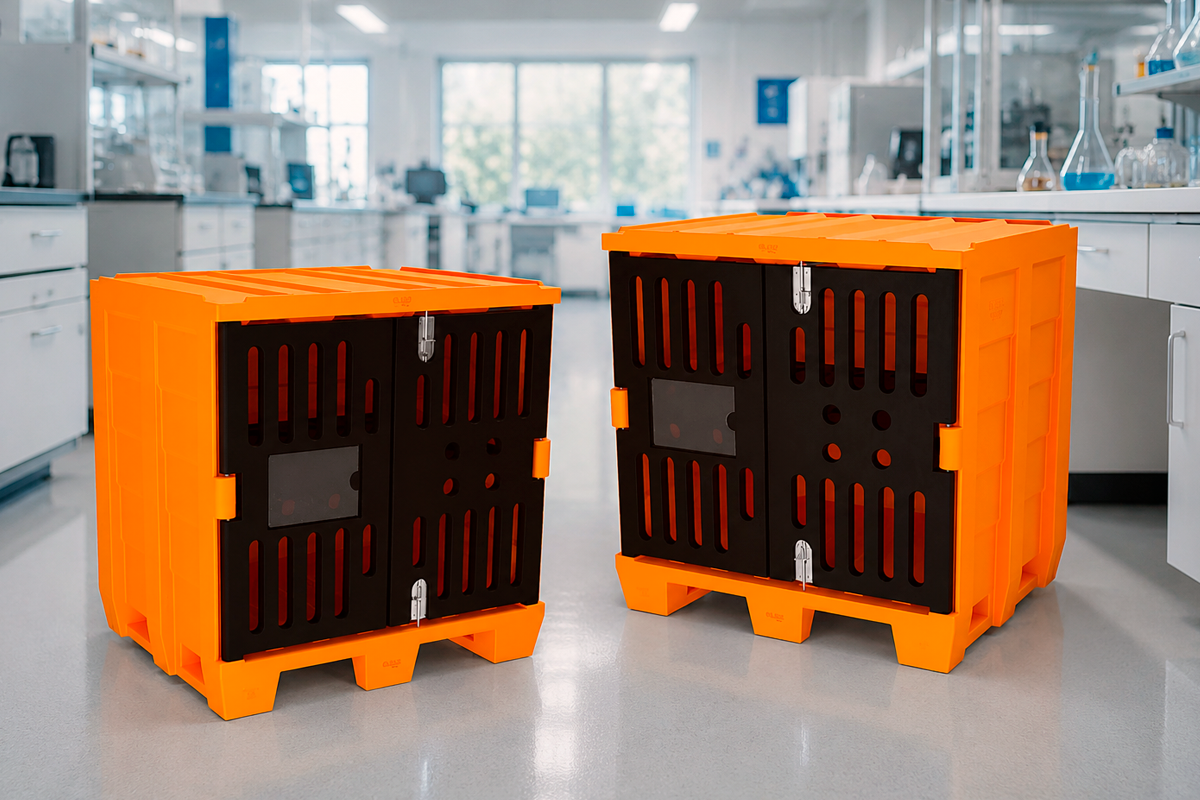
In practice, this requires systems that minimize human error. This is where color-based visual management stands out as an efficient solution. By using colored rotomolded cages, laboratories can create immediate identification for each type of material:
- White: infectious.
- Red: chemical.
- Other colors: common or recyclable, according to internal standards.
This model reduces reliance on reading labels or detailed instructions, making disposal more intuitive. In places with high staff turnover or a large volume of operations, visual clarity makes a direct difference in safety.
In addition, color standardization makes internal and external audits easier, demonstrating compliance with the best practices required by health and environmental regulations.
Meet the rotomolded cages for laboratories
Perfect. This approach is much more strategic because it positions the product as an essential part of the operational routine and not just as a trash bin.
Here’s a suggested rewrite for this section, starting with general operations, moving through rigorous hygiene, and ending with disposal as the final step:
Meet the rotomolded cages for laboratories
In the daily routine of a laboratory operation, biosafety and organization set the pace of productivity. From storing inputs to moving portioned reagents between benches, the cleanliness of the equipment used is a decisive and non-negotiable factor. In environments where process purity is vital, any lapse in sanitary control can compromise months of research or entire production batches.
That’s why choosing the right logistics support materials is strategic. Porous surfaces, seams, or hard-to-reach spots on carts and containers encourage the buildup of microorganisms and chemical residue, creating cross-contamination risks.
In this context, rotomolded cages stand out for their non-toxic, one-piece structure, which makes it easier to perform the rigorous cleaning required both for input segregation and for the subsequent stage: waste disposal. By ensuring equipment that’s easy to sanitize, the laboratory raises its safety standard across every phase of the workflow.
Rotomolded cages follow the same manufacturing standard already known from Tecnotri’s other solutions, which is one-piece construction, with no seams or welds. These technical advantages have a direct impact on cleaning routines.
- Smooth surfaces that make sanitizing easier;
- No gaps where residue can build up;
- Reduced growth of fungi and bacteria;
- Compliance with Anvisa’s required standards.
Compared to metal structures, which can corrode or wear down over time, rotomolded plastic maintains its integrity even after frequent cleaning and disinfection cycles.
This trait is especially relevant in laboratories that use autoclaves or aggressive chemicals, where equipment durability needs to keep up with the demands.
Chemical resistance in critical environments: performance that keeps operations safe
Chemical and pharmaceutical laboratories deal daily with substances that can damage conventional materials. Leaks, splashes, and direct contact with corrosive agents are part of the routine.
In this context, choosing a container for controlled disposal must take into account not only storage capacity, but also material resistance.
Among the advantages of rotomolded cages are:
- Immunity to oxidation, even in contact with chemical agents;
- Structural stability under temperature variations;
- High impact resistance, preventing damage during internal transport;
- Extended durability, reducing replacement costs.
Safe and efficient internal logistics with sanitizable plastic cages
Material management, like waste management, doesn’t end with segregation. Internal transport within laboratories and hospitals also requires attention, especially when it involves hazardous materials.
Rotomolded cages make this process easier because:
- They have a lightweight structure, reducing operational effort;
- They have an ergonomic design, promoting safe handling;
- They have no sharp edges, minimizing risks to workers;
- They’re compatible with handling and stacking systems.
In addition, the ability to see the contents through the grid design allows for greater control without needing to open the units constantly.
The combination of these aspects contributes to a more organized logistics flow, reducing operation time and increasing safety when transporting laboratory waste.
Complementary solutions: Bins and Cargo Safes
While cages are ideal for material flow and quick visualization, other Tecnotri products offer greater efficiency depending on specific needs:
Bin Containers: efficiency in waste disposal
For disposing of waste that requires strict containment, Bin Containers are the best-suited solution. Unlike cages, bins have solid walls and closing systems that ensure the isolation of discarded materials (chemical or biological). Their rotomolded structure resists impacts and corrosive substances, allowing laboratory waste to be stored in a sealed and secure way until final collection, and they also feature a lid for full sealing.
Cargo Safes: maximum protection for sensitive materials
When the priority is transporting high-value inputs or high-risk waste, Cargo Safes come into play. They offer a higher level of protection against external agents. In laboratories, they’re essential for moving large volumes of reagents that cannot be exposed to external contamination, acting as a robust, airtight barrier that complements internal logistics. And with the padlock-closing option, storage becomes even more secure.
Compliance with health and environmental regulations in daily routine
Meeting regulations isn’t just a legal obligation, but a factor that directly impacts the credibility of healthcare and research institutions.
RDC No. 222/2018 sets out clear guidelines for managing health service waste, including steps such as segregation, packaging, identification, and internal transport.
Meanwhile, Conama Resolution No. 358/2005 reinforces the need for containers that prevent leaks and contamination throughout the entire process.
In this context, rotomolded cages contribute to compliance by providing:
- Standardized color-coded visual identification;
- A secure structure for containment;
- Resistant material that prevents leaks;
- Ease of cleaning in line with health requirements.
By incorporating these solutions into their routine, laboratories can reduce compliance risks and strengthen their biosafety protocols.
Why replace metal cages with rotomolded ones?
Metal structures are still common in laboratory operations, but constant use reveals limitations that compromise safety and efficiency over the long term. Beyond the inevitable corrosion from contact with moisture and chemical agents, there’s a critical structural factor: loss of “gauge.”
Under intense daily use, metal cages develop deformations at their joints and weld points, losing their original alignment. When a structure goes out of gauge, stacking becomes unstable and dangerous, drastically increasing the risk of load collapse.
By contrast, Tecnotri’s rotomolded cages are designed to maintain dimensional integrity. Because they’re manufactured as a single piece (monobloc), they have a firm structure and elastic memory, meaning they don’t “warp” with use. This ensures precise and secure stacking, even under heavy use, protecting both workers and stored assets.
Key points to consider when switching:
- Stacking stability: Geometry that stays intact, avoiding collapse risks;
- Chemical resistance and anti-corrosion: They don’t rust or peel, even in harsh environments;
- Superior hygiene: No welds or seams that trap contaminants;
- Operational safety: Lightweight equipment, with no sharp corners or metal edges that could cause accidents.
Replacing metal structures with rotomolded ones represents an operational upgrade. Besides extending equipment lifespan, you eliminate indirect maintenance costs and reinforce biosafety and occupational health and safety (OHS) protocols.
Discover Tecnotri’s solutions for your laboratory
Find out how to optimize your laboratory’s logistics with our full line of rotomolded cages, bins, and containers. Tecnotri develops rotomolded solutions designed to meet the demands of laboratory, hospital, and pharmaceutical environments.
Explore customizable options in colors and configurations, and choose the solution that best fits the specific needs of your operation.