


In 2020, the National Health Surveillance Agency (Anvisa) published a new standard regarding Good Distribution Practices, Storage and Transport of Medicines, the so-called RDC 430/2020.
In today’s article, we will talk about this change and clarify some points of the general regulation of RDC 430. Furthermore, we will explain how Tecnotri can help your company follow the guidelines of this regulation. Check it out below!
What is DRC 430?
The acronym RDC 430 refers to Collegiate Board Resolution number 430, which establishes a quality standard for the logistics and transportation of medicines.
The objective is to guarantee the safety and effectiveness of these goods, which directly impacts the health of the population and employees involved in the loading processes of this type of product.
In addition, among the main requirements of RDC 430 are improvements in all stages of handling medicines and biological materials.
What does RDC 430 of 2020 say?
With the Covid-19 pandemic, the transport, storage and distribution of vaccines was widely discussed by Anvisa. Therefore, some points related to the topic were reevaluated. With the changes, manufacturing, distributing and transporting companies had to adapt to the new resolution, made in October 2020.
Among the main points of RDC 430/2020, we can highlight:
- The industry’s organizational structure needs to be described in an organization chart, with the responsibilities of each person involved indicated in the role of the position. Furthermore, all employees must have training, according to the complexity of the activity performed.
- There needs to be a Quality Management System, which maps all processes related to aspects that impact the quality of medicines and services provided.
- Locations where medicines are stored require a specific structure, which contains separate reception and dispatch areas, deposits for cleaning materials, administrative environments, canteens and/or cafeterias, toilets and washbasins without direct communication with the medicines’ storage spaces, in addition to specific areas for each type of medicine (returned, rejected, expired, etc.).
- Storage conditions must follow the guidelines of the registration holder and comply with the loading condition determined for the medicine.
- To transport medicines, it is necessary to qualify the team involved and provide assistance in case of accidents.
- Regarding thermolabile medicines, the maximum temperature must be equal to or lower than 8°C. Therefore, as they are sensitive, during logistics processes, exposure to ambient temperature needs to be minimized.
How to adapt to RDC 430?
There are some strategies that can help implement and/or improve good practices in the transportation, storage and monitoring of medicines, including:
-
Map the processes
The manufacturer must maintain medicines in accordance with what is specified on the labeling during all phases of service. Therefore, when traveling this production chain, your company must prioritize mapping processes, identifying errors and prioritizing solutions.
-
Carry out inspections regularly
Inspections are effective ways to increase the quality of processes. Count on trained professionals in the area and carry out this practice frequently. This way, it is possible to review procedures and detect errors.
-
Use of appropriate equipment
Opt for transport and storage equipment that is guaranteed to be effective and provides adequate security, both for medicines and for those who handle this type of merchandise.
What happens to those who do not comply with RDC 430?
Industries that fail to comply with the requirements of RDC 430 are held responsible and subject to high fines.
How can Tecnotri help you adapt to RDC 430?
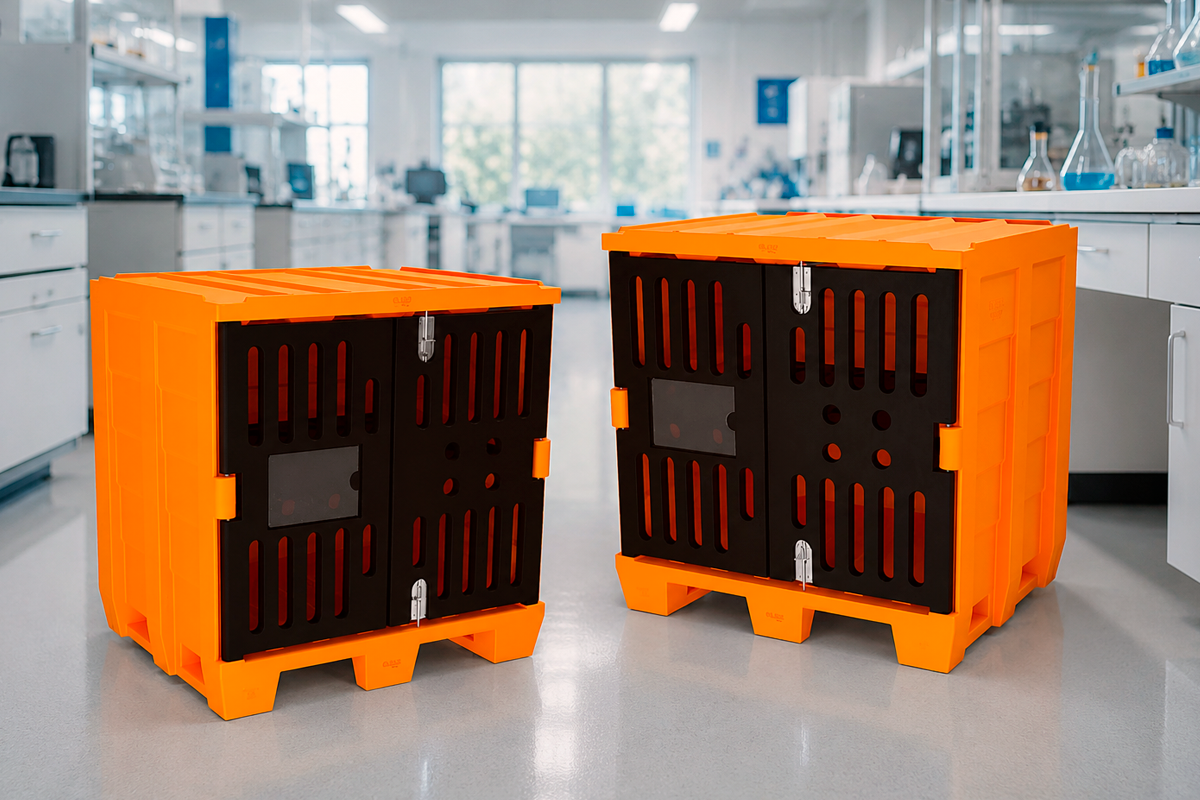
Tecnotri has developed an effective and modern solution: the Pro Therm Safes, ideal for pharmaceutical industries.
Made from 100% virgin rotomolded plastic, they have a UV-14 additive and are impervious to water and dust. Furthermore, they stand out for supporting temperature variations between -70°C to 60°C and are available in three size options: 115, 300 and 560L.
This makes Tecnotri’s line of Pró Therm Safes comply with Anvisa’s requirements and the guidelines of RDC 430/2020, to transport vaccines with safety and integrity.
Check out other product differences:
- Triple layer to control temperature;
- Area for seals and padlocks;
- Extremely safe and resistant;
- Easy to clean;
- Built-in closure and stainless steel articulated lock;
- Stacking possible;
- Optional Foil Holder and Thermometer;
- Compatible with Datalogger;
- High load segregation.
Discover Tecnotri’s line of Pró Therm Cargo Safes
Check out all the details of Tecnotri’s line of safes and comply with the standards of RDC 430.